The energy system is fundamental for a growing society and economy, but it has to become decarbonized
Without energy provision, societies and economies across the globe would not work. Transport, digitalization, the construction of critical infrastructure and communication, among others, are depending on and fueled by energy (Ramdoo 2024, 6ff.). In 2023, the industry sector had the highest share in the global final consumption of energy (30%), followed by the transport sector (29%), the residential sector (20%) and the commercial and public service sector (8%) (IEA 2025). On the household level, energy is to a large extent used for heating and residential appliances (IEA 2025).
Absolute and per-capita energy use increased significantly over time, as societies across the globe were and are still growing and becoming more affluent. In Asia, for instance, per-capita energy use more than doubled between 2000 and 2024, in Latin America and the Carribean, it increased by 24% in the same period (EIA 2025).
In the past, the transition from a biomass-based to a fossil-based energy provision system, consisting of abundant fossil energy carriers like coal, gas and oil, enabled to meet growing energy demand (Winiwarter 2011). However, the high dependency on fossil-based energy provision is an overarching challenge of our time, as GHG emissions from fossil energy combustion are a main driver for climate change and related impacts (Dhakal et al. 2022). Hence, tackling climate change constitutes a transition of our energy system towards renewable energy carriers (Dhakal et al. 2022). The need for this transition is even more urgent before the background that, by 2050, the world’s population will further increase to ten billion people, coupled with rapid urbanization and economic development (Ramdoo 2024, 6ff.).
In 2024, the global share of renewable energy in primary energy consumption was only 15% (Energy Institute 2025). World regions respond to the need for an energy transition with ambitious strategies; the deployment of clean energy technologies, for instance, is part of national climate pledges through the Paris Agreement (of staying well below 2°C above pre-industrial levels) (Ramdoo 2024). SDG 7 of the UN Agenda 2030 aims to “increase substantially the share of renewable energy in the global energy mix” by 2030 and to triple the global capacity for renewable energy production (UNSD 2025). Chinas 5-year plan 2026-2030 includes that, by 2030, renewables should have a 25% share in total primary energy consumption (CSET 2021). With the Green Deal and the recast of the Renewable Energy Directive, the EU strives for a Renewables share of 45% in the gross final energy consumption by 2030 (European Commission 2023).
Critical raw materials and their importance for the energy transition
While allowing to decarbonize, renewable energy and related technologies are highly intensive regarding a number of raw materials not used in a fossil-based energy system. For example, copper demand for wind power generation is expected to be up to 40 times higher per energy unit than for fossil-based energy generation (UN 2023, 3ff). Hence, ambitions towards renewable energy systems, infrastructure and societies imply a relocated dependency from fossil energy carriers to metals and minerals, especially so-called critical raw materials (CRMs) (IEA 2022, 5ff). CRMs are metals and minerals of high national, economic and strategic importance. CRMs, including Lithium, Nickel, Cobalt and Copper, are indispensable for key energy transition technologies (European Commission 2023b). An electric vehicle, for instance, contains more than 200 kilograms of CRMs, notably Copper, Lithium and Nickel, whilst a conventional vehicle contains only 40 kilograms, notably Copper (IEA 2022).
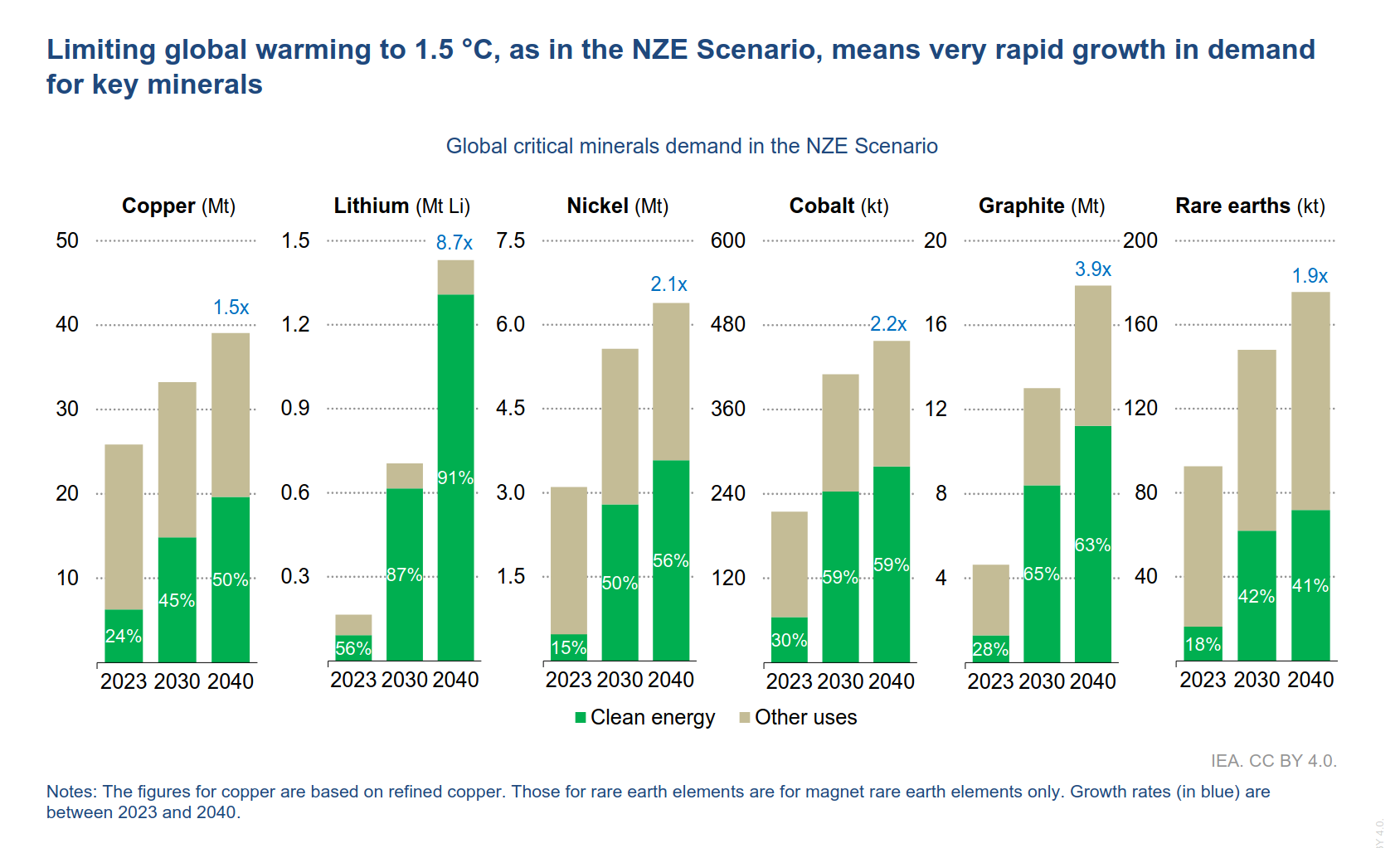
Correlation between the Paris Agreement, net-zero commitments of countries/regions and the increased appropriation of several CRMs (IEA 2024b, 96)
For the presented ambitions towards a decarbonized energy system, CRM demand will increase steeply. Meeting the Paris Agreement correlates with a quadrupling of mineral demand by 2040 (Ramdoo 2024, 7). The above figure mirrors that meeting the Paris Agreement, as well as the net-zero targets of countries correlates with a tremendous increase in the appropriation of several CRMs, especially for transforming the energy system (green bars) (IEA 2024b).
CRM supply chains are vulnerable and their disruption can have far-reaching impacts
The extraction of a large number of CRMs is highly geographically concentrated, a characteristic that makes them susceptible to price volatilities and their supply chains vulnerable to disturbances (EC 2023b). In 2023, CRM extraction was concentrated on several extracting regions in the Global North and Global South. The figures below display exemplary the Domestic Extraction of Nickel and Copper ore concentrates and compounds up to 2024; Nickel extraction was largest on the Asian-Pacific continent (62% share in material extraction), especially in Indonesia, the Philippines and New Caledonia. Copper extraction was largest in the USA, Chile and China. Some countries are even single providers of CRMs, like Russia for Palladium or the Democratic Republic of the Congo for Tantalum (see also our map visualization, underpinning the concentration of CRM extraction to countries) (EC 2023b).
As presented in our story on Material Consumption, globalization links to a “detachment of production and consumption” in geographical terms; this is also the case for CRMs. Transferring extracted CRMs to regions of processing and final consumption generates a displacement effect, implying huge gaps between a country’s or a region’s domestic extraction (DE) and material footprint (RMC) for CRMs. This is illustrated in the figure below, showing DE and RMC in Africa and Europe exemplarily for Copper and Nickel for 2015 and 2021. As an extracting region of the Global South, DE of Copper and Nickel in Africa is significantly higher than RMC in both years. In contrast, Europe had a high material footprint, compared to a small domestic material extraction of Copper and Nickel (DE of 109 million tonnes in 2021, compared to RMC of 305 million tonnes in 2021, for the case of Nickel).
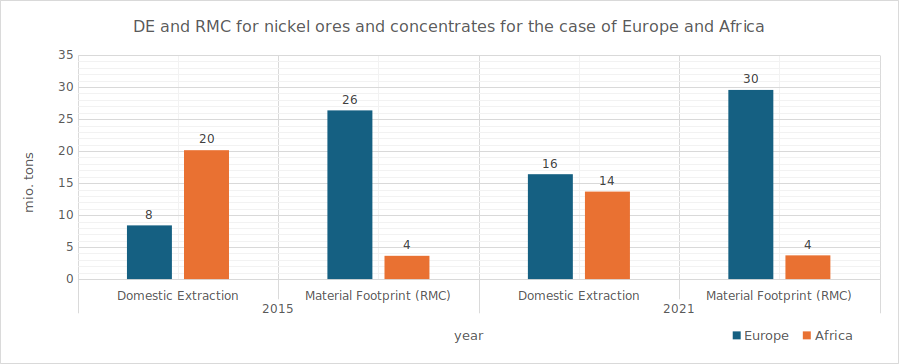
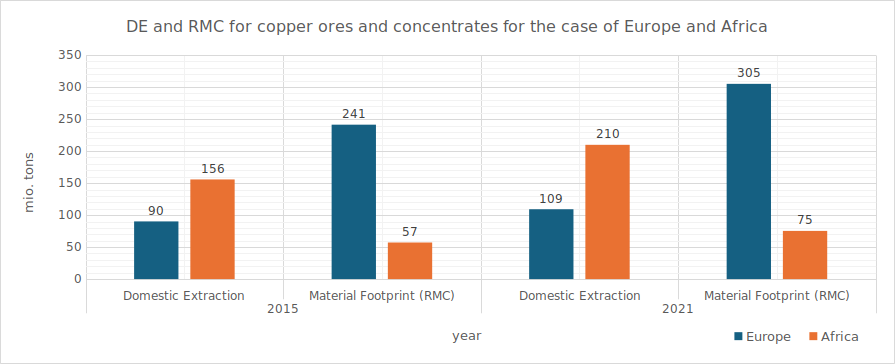
Gap between domestic extraction (DE) and the material footprint (RMC), exemplary for extracting regions of the Global South (Africa) and consuming regions of the Global North (Europe) for 2015 and 2021 for copper and nickel ores and concentrates
Due to this extractive concentration, disruptions in the CRM supply chain – including physical disruptions, trade restrictions, or geopolitical developments – can have far-reaching impacts, as they affect upstream industries as well as consuming economies through higher end prices or supply interruptions. A sustained price shock for battery metals, for instance, is likely to increase battery end prices by up to 50%. As CRMs are often not (yet) substitutable, price volatilities are amplified, and there is only limited flexibility to respond to disrupted supply chains (IEA 2024; IEA 2025b). Regions are intensifying efforts to decentralize and thus secure supply chains of CRMs. The EU, for instance, designated 47 projects under the EU Critical Raw Materials Act for scaling-up secure domestic CRM supply chains (IEA 2025b). By 2030, at least 10% of the EUs domestic CRM consumption is to be sourced domestically (Ramdoo 2024).
Increased CRM demand requires establishing supply chains aligning with socio-environmental sustainability
The imperative of the energy transition overshadows that CRM supply chains are connected to a multitude of socio-environmental conflicts, including child labor, safety issues during extraction, and long-term ecological harm alongside the lifecycle of CRMs (see also out story on the nexus between Mining Activities and Deforestation). This undermines the UN SDGs that should be supported by CRM extraction and use (UNECE 2024). Amid rising CRM supply concentration and pressing demand for CRMs, extractive economies like China, the Democratic Republic of the Congo and other (emerging) regions of the Global South deployed export restrictions for CRMs. As for 2025, the majority of energy-related key minerals are subject to (temporary) export controls (IEA 2025b). As refining usually happens in the Global North, these trade restrictions serve primarily to stimulate (economic) beneficiation for extracting economies and to increase their industrialization processing capacities (Ramdoo 2024).
According to the European Commission, the secured access to CRMs requires a higher proportion of materials sourced from recycling, as it reduces the EU’s import dependency. The EU aims to achieve a recycling rate of 25% for CRMs by 2030 (European Commission 2024b). With increasing CRM demand and higher energy costs of extraction due to declining ore grades, higher recycling rates have become a viable option. For instance, recycling platinum requires 90 % less energy than primary extraction (Eisenmenger et al. 2020). However, in 2023, only aluminum, copper and tungsten had a recycling rate above 25%, while other CRMs had rates well below 10%. Reaching a CRM recycling rate of 25% strongly depends on further research, development, and on innovative solutions. For several CRMs, like neodymium or lithium, secondary resources in waste streams are currently inadequate to meet expected CRM consumption levels. Thus, consumption patterns also determine, whether set recycling targets are feasible (Tröster, Papathephilou and Küblböck 2024).
Taking all these aspects into account, it becomes inevitable to establish a responsible management of CRM, the UN Expert Group on Resource Management addressed the issue with a framework for managing CRMs in a more sustainable and transparent way, including the UN Framework Classification System (UNFC), the UN Resource Management System (UNRMS) toolkit, as well as several policies for recycling, circular economy and decarbonizing energy intensive industries (UNECE 2024, 8ff.). Not only responsible sourcing of CRMs aligns with several SDGs, but also tackling supply risks, as these can undermine several SDGs; for instance, CRM supply disruption affects the health sector by limiting availability and affordability of medical devices or the access to clean and affordable energy (UN 2023, 3). At the same time, establishing transparency and responsible sourcing of CRMs could be jeopardized by the fear of excessive reporting burdens and related initiatives aiming to reduce administrative efforts for businesses and stakeholders such as the Omnibus Directive I adopted by the European Commission in 2025, which drastically reduces the number of companies obliged to do comprehensive sustainability and due diligence reporting (European Commission 2025, 2ff.).
The paradigm of increasing CRM extraction for the energy transition oversees impacts and risks associated with the extraction of CRMs. In essence, the quality of the transition towards decarbonized and circular economies and societies depends immensely on how aspects such as supply chain sustainability, circularity and security are taken into account. In this context, a crucial aspect is that of sufficiency, because by maintaining growth rates in energy demand, decarbonization merely shifts the problem from fossil fuels and climate change to metallic/mineral resources and their associated social, economic and environmental impacts.
References
CSET (2021). Outline of the People’s Republic of China 14th Five-Year Plan for National Economic and Social Development and Long-Range Objectives for 2035. Available at: https://cset.georgetown.edu/wp-content/uploads/t0284_14th_Five_Year_Plan_EN.pdf
Dhakal, S. et al. (2022). Emissions Trends and Drivers. In IPCC, 2022: Climate Change 2022: Mitigation of Climate Change. Contribution of Working Group III to the Sixth Assessment Report of the Intergovernmental Panel on Climate Change. doi: 10.1017/9781009157926.004
Eisenmenger, N. et al. (2020). Ressourcennutzung in Österreich 2020. Band 3. Wien: BMK.
Energy Institute – Statistical Review of World Energy (2025).
European Commission (2023). Directive (EU) 2023/2413 of the European Parliament and of the Council of 18 October 2023 amending Directive (EU) 2018/2001, Regulation (EU) 2018/1999 and Directive 98/70/EC as regards the promotion of energy from renewable sources, and repealing Council Directive (EU) 2015/652. http://data.europa.eu/eli/dir/2023/2413/oj
European Commission (2023b). Study on the Critical Raw Materials for the EU 2023 – Final Report. Brussels: European Commission. https://op.europa.eu/en/publication-detail/-/publication/57318397-fdd4-11ed-a05c-01aa75ed71a1
European Commission (2024a). CORDIS Results Pack on processing and recycling of raw materials. A thematic collection of innovative EU-funded research results. https://publications.europa.eu/resource/cellar/7255ef18-ae6c-11ef-acb1-01aa75ed71a1.0001.01/DOC_1
European Commission (2024b). Regulation (EU) 2024/1252 of the European Parliament and of the Council of 11 April 2024 establishing a framework for ensuring a secure and sustainable supply of critical raw materials and amending Regulations (EU) No 168/2013, (EU) 2018/858, (EU) 2018/1724 and (EU) 2019/1020 (Text with EEA relevance). http://data.europa.eu/eli/reg/2024/1252/oj
European Commission (2025). Proposal for a DIRECTIVE OF THE EUROPEAN PARLIAMENT AND OF THE COUNCIL amending Directives 2006/43/EC, 2013/34/EU, (EU) 2022/2464 and (EU) 2024/1760 as regards certain corporate sustainability reporting and due diligence requirements. EUR-Lex – 52025PC0081 – EN – EUR-Lex
IEA (2022). World Energy Outlook Special report. The Role of Critical Minerals in Clean Energy Transition. https://www.iea.org/reports/the-role-of-critical-minerals-in-clean-energy-transitions
IEA (2023), Renewables share of total energy supply in the Net Zero Scenario, 2010-2030, IEA, Paris https://www.iea.org/data-and-statistics/charts/renewables-share-of-total-energy-supply-in-the-net-zero-scenario-2010-2030-2
IEA (2024). Recycling of Critical Minerals Strategies to scale up recycling and urban mining A World Energy Outlook Special Report. https://www.iea.org/reports/recycling-of-critical-minerals
IEA (2024b). Global Critical Minerals Outlook 2024. https://www.iea.org/reports/global-critical-minerals-outlook-2024
IEA (2025). World Energy Statistics and Balances. Paris: IEA. Access: https://www.iea.org/data-and-statistics/data-product/world-energy-statistics-and-balances
IEA (2025b). Global Critical Minerals Outlook 2025. https://www.iea.org/reports/global-critical-minerals-outlook-2025
Ramdoo, I. (2024). Critical Raw Materials: A production and trade outlook. Perspectives from Africa, the Caribbean, and the Pacific States. International Institute for Sustainable Development.
Tröster, B., Papatheohilou, S. and Küblböck, K. (2024). In search of critical raw materials: What will the EU Critical Raw Materials Act achieve? An analysis of legal and factual implications of the CRMA. Wien: ÖFSE. In search of critical raw materials: What will the EU Critical Raw Materials Act achieve?
UN (2023). UN-ENERGY POLICY BRIEF Aligning Critical Raw Materials Development with sustainable development. UN Department of Economic and Social Affairs.
UNECE (2024). Critical Minerals for the Sustainable Energy Transition. A Guidebook to Support Intergenerational Action. Geneva: UNECE.
EIA (2025); Energy Institute – Statistical Review of World Energy (2025). Energy Production and Consumption – Our World in Data
UNSD (2025). The Sustainable Development Goals Extended Report 2025. United Nations Department of Economic and Social Affairs.
Winiwarter, V. et al. (2011). A Socio-metabolic Transition towards Sustainability? Challenges for Another Great Transformation. Sustainable Development. 19. 1–14. 10.1002/sd.410.
World Bank (2025). Tracking SDG 7: The Energy Progress Report. World Bank, Washington DC.
Content
- The energy system is fundamental for a growing society and economy, but it has to become decarbonized
- Critical raw materials and their importance for the energy transition
- CRM supply chains are vulnerable and their disruption can have far-reaching impacts
- Increased CRM demand requires establishing supply chains aligning with socio-environmental sustainability