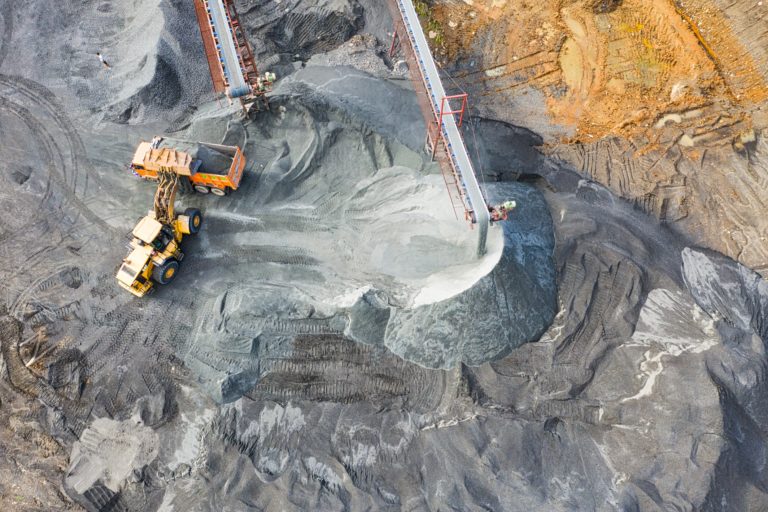
The concept of telecoupling
In line with general trends of economic globalization, the trade of raw materials shows tendencies towards greater internationalization. Consequently, we observe two phenomena: first, high-income countries such as Austria consume goods which are based on materials mainlywh from other countries. Second, some (mostly low-income) countries are specialized exporters of certain materials. Consequently, global production and consumption of raw materials happen in geographically apart regions, which are interlinked via global supply chains. This phenomenon is often called “telecoupling”. This separation of production and consumption comes with differentiated economic and ecological impacts for different world regions. A focus on metallic minerals allows for an illustrative case of such “Unequal Ecological Exchange”.
The material footprint of Austria is increasingly internationalized
High-income countries such as Austria show high and increasing levels of raw material consumption. However, we observe that less raw material is extracted and processed directly in Austria. The difference can be explained with the help of the concepts of domestic material consumption (DMC) and Material Footprint (MF). Since in the last decades, the extraction and processing plants of raw materials have been relocated towards countries of the Global South (notably China), less raw material is processed directly in Austria. Instead, the first steps in the supply chain of many products are located outside of high-income countries and only semi-finished and finished products are produced in high-income countries. The MF accounts for this dynamic and goes beyond the DMC. It includes not only raw materials used in Austria, but all material along the supply chain that went into the goods consumed.
The figure above shows that the MF of Austria increased between 1990 and 2024 from 191 to 241 million tons. In the same period, the share of materials that came from foreign sources increased from 57% to 71%. This shows that Austria is satisfying its material demand increasingly with materials from abroad. For 2022, the figure below depicts the international origins of Austria’s MF. Main countries of origin are Germany, Russia, China, and Poland.
Specialized producer countries deliver to high-income consumer countries
Zooming out from the case of Austria reveals a more general pattern in the trade of raw materials. We observe that the flow of raw materials is structured along relationships of production and consumption with some countries focusing on production and others mostly on refinement and consumption. The below figure shows that some low-income countries such as the DR Congo, Indonesia and the Philippines tend to contribute more to foreign consumption via their exports than they profit from extraction abroad via imports. These countries are called “net-eporters”. In contrast, high-income countries like Germany and the United States are net importers. Reasons for this functional split include the occurrence of deposits and the positioning in global value chains. The figure below provides an example for this split. The countries depicted have among the biggest and purest reserves for cobalt (DR Congo, Indonesia) and nickel (Indonesia, Philippines). This makes them attractive for the exploitation of these metals which are used for strategic industries such as semiconductor chips and electric vehicles. But the figure also represents the way global value chains are structured internationally. The first steps in the production process (extraction and processing of raw materials) tend to be in low-income countries while the later steps (industrial production, assembly, marketing) happen in high-income countries, in this case in Germany and the United States for America. This has socio-economic and political implications.
Unequal Ecological Exchange between producer and consumer countries
Countries of raw material production and raw material consumption are differently affected by their position in the value chain of goods. While ecologically (and socially) detrimental impacts tend to be concentrated in the first steps of the supply chain, economic benefits accumulate in the final stages of supply chains. The extraction of raw materials comes with a whole range of negative impacts for the local communities (Story Mining and Deforestation). Examples include the loss of fertile land for mining activities, the pollution of groundwater and soil, and the reduction of agricultural production. The processing of raw materials is also a highly polluting industry which has increasingly been relocated from high-income countries to lower-income countries. Moreover, the oligopolistic nature of the commodity trading market allows multinational trading companies to impose low commodity prices and poor working regulations in the mines. Consequently, economic benefits are minimal for local communities. By contrast, companies that are positioned at the end of the supply chain (which are often high-income countries) can realize substantial profits from their activities. We observe a difference between the high amount of semi-processed physical material that flows from peripheric countries to core countries and the low amount of monetary renumeration flowing back. This imbalance is coined “Unequal Ecological Exchange (UEE)”.
Bend the trend towards more equal exchange – better policy is needed
An example of UEE in practice, is the EU-MERCOSUR agreement. In its core, it aims at reducing barriers for the import of raw materials and agricultural products such as beef, pork and metals from the Latin American trading partners towards the EU. In return, the export of cars, chemical products and pesticides towards Argentina, Brazil, Uruguay, and Paraguay shall become easier. Critics highlight that the agreement comes at the expense of local communities, an intensification of rainforest deforestation, the reduction of social and environmental standards, and the deindustrialization in MERCOSUR countries. At the same time, European farmers as well as its mining industry face increasing competition from Latin American. To reduce inequalities in global supply chains and ensure diversified economies among trading partners, policies need to encourage social and environmental protection and protect the needs of local communities in low-income countries. Concrete examples include supply chain regulation, debt cancellation, and the inclusion of local communities in decision making regarding material exploitation.
Content
- The concept of telecoupling
- The material footprint of Austria is increasingly internationalized
- Specialized producer countries deliver to high-income consumer countries
- Unequal Ecological Exchange between producer and consumer countries
- Bend the trend towards more equal exchange – better policy is needed