The concept of decoupling in politics
When the landmark report “The limits to growth” was released by the Club of Rome in 1972, it marked the beginning of a discussion that is present to this day: Can we (infinitely) grow our economies on a planet with finite resources? Since the 1970ies, global raw material extraction has tripled. This observation is in line with the so-called great acceleration which describes that several indicators of environmental degradation and of material consumption have been increasing (strongly) in the last five decades.
The “Policy Dashboard” on materialflows.net compiles policy examples from Europe, where specific targets have been set in response to high material consumption levels, and shows how far individual countries around the globe are from achieving these targets. It supports ex-post assessments whether material use (and related negative impacts for people and planet) can (sufficiently) be decoupled in a scenario of economic growth. Using Austria and Finland as examples, this story illustrates the functionalities of the Policy Dashboard.
When talking about resource use in the context of economic development, several political approaches exist. The most prominent is the concept of decoupling. It essentially describes the process of making economic development (increasingly) independent from environmental exploitation and degradation, such as the extraction of raw materials or the emission of pollution (see the story on Decoupling material use and economic performance). The concept has been taken up by the paradigm of “Green Growth” which proposes the hypothesis that decoupling is possible in a context of economic growth.
Green Growth is at the heart of the UN’S SDGs which states economic growth as a goal (Goal 8) next to the protection of ecosystems (Goals 13, 14, 15); also, the “Green Growth Strategy” of the OECD and the EU’s European Green Deal explicitly aim for economic growth and decoupling. In this vein, an increasing number of national strategies apply the concept of decoupling (and Green Growth, respectively).
Indicators of decoupling
To investigate whether Green Growth is possible, scholars study the relationship between GDP trends and those of different measures of material demand. The most important are domestic material consumption (DMC) and raw material consumption (RMC) (for indicator definition refer to our Methods section). In comparison to the raw materials directly consumed within a country (DMC), the RMC accounts for all materials extracted along the supply chains to produce goods that are consumed in a country. Hence, if industries with high material demand are shifted to other countries, the DMC might decrease while the RMC stays the same (see story on The concept of material consumption). Another decoupling indicator often used in policy making is ‘material productivity’ (also: ‘resource productivity’), defined as the amount of economic value created from one unit of material (GDP/DMC or GDP/RMC). While this indicator allows for a relative assessment of material productivity of economic processes, it fails to account for absolute limits.
Case Study: Austria’s material consumption
The Austrian National Circular Economy Strategy defines targets for both domestic material consumption (DMC) and raw material consumption (RMC). By 2030, it aims to reduce the DMC per capita to 14 tonnes. With 15.3 tonnes per capita in 2021according to the IRP MFA database, a reduction of 8.2 % or 0.14 tonnes per year is needed. As can be seen in the figure above, the overall decreasing trend of DMC per capita levels is consistent with the policy aim. Other countries with similar per capita GDP levels, like the UK or the Netherlands, have a DMC below 14 tonnes (11.5 and 11.3, respectively), while Canada currently stands at 56 tonnes (see the Policy Dashboard for details). Reasons for these differences can be found in climatic conditions, socio-economic structures, etc.
For RMC, according to the UN International Resource Panel, reaching a global average of 6-8 tonnes per capita in 2050 would be compatible with planetary boundaries. The Austrian Circular Economy Strategy adopted this target and aims to reduce the RMC to 7 tons per capita by 2050. Here, the difference from the current level to the target is substantially larger than for DMC. In 2021, Austria’s per capita RMC was 25.2 tonnes. To achieve the target of 7 tonnes per capita by 2050, a reduction of 72.3 % or 0.6 tonnes per year is needed. The figure above illustrates that if current trends continue, the defined target will not be met. Finland, the Netherlands, and Canada show an even larger distances to the target of 7 tonnes of RMC per capita (23.4t, 24.8t, 33.0t, respectively; see the Policy Dashboard for details).
Case study: Finland’s material productivity
SDGs 8 and 12 aim at increasing resource productivity globally and by that means decouple economic growth from supply chain wide material consumption. At the national level, for example, Finland’s Roadmap to the Circular Economy 2.0 aims at doubling material productivity by 2035 compared to 2015. In 2015, the country’s material productivity was at 1.45 US$/kg. With 1.53 US$/kg in 2021, Finland needs an annual increase of 6.5% or 0.1 US$/kg to reach the target (2.9 annual increase of 6.48% or 0.10 US$/kg, table below).
A comparison with other countries with similar productivity levels in 2015 shows that Uruguay achieved a greater productivity increase (35.2%) than Finland and is hence closer to doubling its material productivity (GDP/RMC) by 2035. This development in Uruguay can be explained by a strong reduction of RMC from 2019 to 2020 due to the Covid pandemic. In contrast, Portugal and Singapore faced a productivity decrease (table below).
Pathways to a sustainable level of resource use
Empirical data raises doubts about the idea that economic growth and material demand can be decoupled without a serious transformation of our economic system. As shown by Parrique et al., it is unlikely that efficiency measures alone are able to absolutely, globally, and permanently delink a constantly growing economic metabolism from its biophysical base. Hickel and Kallis similarly argue that, while a relative or even absolute decoupling might be possible for limited periods in selected regions, a general decoupling that is strong enough to maintain a healthy state of our environment is unlikely to happen.
Raw material use and greenhouse gas (GHG) emission are closely intertwined (see story Circular Economy: the nexus to GHG emissions – materialflows.net). According to the International Resource Panel (IRP), bold and innovative policy measures are required to achieve material use within planetary boundaries and at the same time reduce GHG emission to sustainable levels. Scenario modelling in the IRP Global Resources Outlook 2024 showed that by integrating action on resource efficiency and circular economy, driving the energy transition, and changes in diets and farming practices a sustainability transition can be achieved until 2060. An integrated approach shows significantly larger positive effects than isolated measures (UN IRP, 2024, figure below). It’s more, until 2060, global per capita material use can be absolutely decoupled from economic development, well-being and environmental impacts, with reductions in high and upper middle-income countries outweighing increases in low and lower middle-income nations.
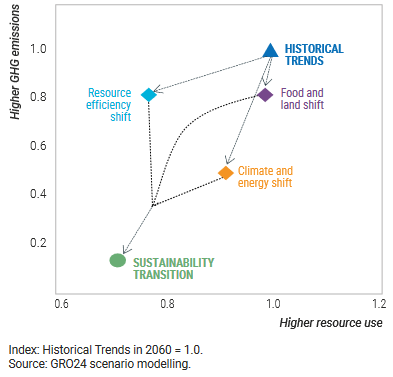
UN IRP, 2024
The targets discussed here are taken from national strategies in European countries, and trajectories are compared to countries with similar circumstances. To incorporate differentiated historic raw material consumption levels, targets for lower-income countries would need to look differently, potentially less ambitious to allow for the development of their economies and construct infrastructures.