Patrick Rasenberg
Doing more with less:
Decoupling economic growth
from resource use and environmental harm
Global economic and social development has come along with a steady increase in global resource use. Today, it has reached a level that threatens the sustainable functioning of the earth’s ecosystems and their capacity to deliver the material conditions for a decent life for societies across the globe. On the contrary, societies keep on striving for economic growth as the main driver for development. A discussion about how to harmonise economic and environmental goals is ongoing on various political levels.
Most prominently, the Sustainable Development Goals (e.g. SDG 8.4 and SDG 12.2, see the UN initiatives below) call for breaking the link between “environmental bad” and “economic good”, as framed by the OECD and the UN International Resource Panel (UN IRP) . This “decoupling” process would allow economic growth while reducing environmental pressures and impacts brought about by resource use, with the aim of enabling human development within “planetary boundaries”.
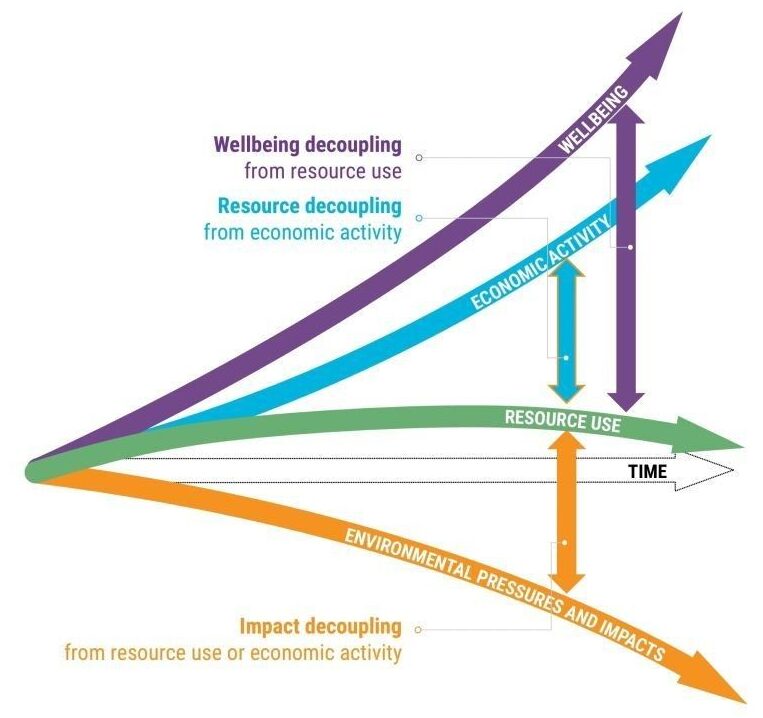
Currently, the political debate focuses mainly on “resource decoupling” in production processes, i.e., increasing resource efficiency by using less material per unit of output and the related value created. Yet, the concept of decoupling also refers to other dimensions: Breaking the link between human wellbeing – instead of economic activity – and resource use is referred to as “wellbeing decoupling”, while the detachment of economic activity or resource use from environmental impacts is referred to as ”impact decoupling” (see Figure on the left).
Only few of the policies or strategies applying the decoupling concept specify which type of decoupling they refer to. Also, it is often not declared if the policies’ aim is relative or absolute decoupling. Both see the economy or well-being increasing. But relative decoupling allows for an increase in resource use and related impacts, albeit at a lower rate, while absolute decoupling sees a decrease in environmental harm. From a sustainability perspective, only absolute decoupling is considered a meaningful strategy allowing societies to thrive within planetary boundaries. Further information on decoupling and related enabling conditions can be found in the Global Resource Outlook 2024 by the UN IRP.
To date, there is no evidence of absolute decoupling on a large scale; only a few countries follow the trend of absolute decoupling and only for a certain period (see also our story on the decoupling concept). In the literature, it has been argued that, at large scale, it is not feasible to reduce environmental and social impacts without reducing absolute resource use, and that a reduction of resource use is only possible when economic activity is also in decline.
Initiatives and strategies applying EW-MFA
Currently, levels of material consumption differ significantly across countries and world regions, depending on the level of industrialization and wealth. For instance, in 2024, the EU average per-capita material footprint (RMC) was at about 21t, in contrast to India with around 5t. Hence, industrialized countries need to focus on absolute decoupling, aiming at a considerable reduction of resource use. Relative decoupling should be propagated in those contexts where an increase in resource use is still required to enable dignified living, as well as social and economic development (notably, regions of the Global South). Reaching these goals requires a high level of ambition.
A rapidly growing number of policies and initiatives on the national, European and international level tackle the topic of sustainable resource use. Many of the following examples identify the increase in resource efficiency as important means to augment the material productivity of production and consumption activities, and, eventually, decouple economic growth from resource use. To measure progress, indicators based on the concepts of EW-MFA are used. For further information on the performance of individual countries related to international and national policies on decoupling and resource use, visit our policy dashboard.
Transnational – UN, UNIDO, UNEP
UN Sustainable Development Goals
UNIDO Green Industry Strategies
UN guidance for MFA application and monitoring
The UN offers several products that support countries in tracking progress towards achieving the SDGs. Together, UNEP, IRP, UNSD, Eurostat, and the OECD developed a modular manual on EW-MFA to support countries in the development of their own MFA accounts. It specifically addresses issues related to economies with a strong focus on resource extraction. In addition, a step-by-step guide was created to support the compilation of MFA accounts. In this context, the Global Footprint Tool, developed by the UNEP, allows to calculate and analyze material footprints, among other environmental dimensions. Whilst own national accounts are not established yet, the IRP is providing the Global Material Flows Database, which is a harmonized database enabling inter-country comparisons as well as the monitoring of material flow trends for individual countries. The database is also the backbone of the UNEP Global Resource Outlook. Finally, also the Green Economy Progress (GEP) Measurement Framework, developed in collaboration of several UN organisations, employs Green Economy Indicators, including MFA-based indicators.
Transnational – others
OECD Green Growth Strategy
In 2011, the OECD developed the Green Growth Strategy which promotes the pursuit of economic growth and development while safeguarding natural assets as the basis for human well-being. It features a database with key indicators – Green Growth Indicators and Environment at a Glance Indicators – for monitoring progress towards a green transition and green growth. One feature of the databases relates to circular economy, presenting MFA-derived indicators, among others.
G20 Resource Efficiency Dialogue
The G20 Resource Efficiency Dialogue, formed in 2017 by the G20 members, aims to make efficient and sustainable resource use a key topic of the G20 talks. The G20 members provide status reports on their circularity and resource efficiency performance, including information on several MFA-related indicators like the Circular Material Use Rate, DMC, and recycling input rates.
Green Growth Knowledge Partnership
Regional – European Union
Building on the EU Green Deal, the EUs 8th Environmental Action Programme (EAP) from 2022 sets out a vision for the EUs environmental policy up to 2030. The EAPs are closely related to the EU environmental economic accounts regulation, which makes reporting of MFA data mandatory. The corresponding environmental accounts dashboard uses several MFA-derived indicators.
The Material Footprint and the Circular Material Use Rate are also two of the 28 headline indicators and corresponding targets to assess progress towards a sustainable EU, fostering a regenerative circular EU economy. Complementary, the EU has adopted several initiatives on resource efficiency and circularity, which use MFA-derived indicators.
EU raw material policies
EU circular economy initiatives
The EU Clean Industrial Deal, launched in 2025, sees circularity as a cornerstone to foster competitive and resilient EU material supply chains with reduced trade dependencies. One important element is the EU Circular Economy Act, adopted in 2026. It identifies the overarching target to increase the EU’s circularity rate to 24% by 2030. Several EW-MFA-related indicators are part of the EU Circular Economy monitoring framework.
The EU Circular Economy Stakeholder Platform serves as a forum to promote the implementation of the EUs circular economy polices. This is done through civil society consultation, fostering cooperation between networks, and communications on how to accelerate the circular transition. The platform also hosts a database for commitments on sustainable production and consumption, as well as toolkits and guidelines for best practices.
Regional – Africa
Africa's Circular Economy Plan
The Circular Economy Plan of Africa (2024-2034) is a strategic framework. It sets the long-term strategic goals for resource efficiency and sustainable industrialization across the continent, aiming to promote green growth, resource efficiency, and a competitive circular economy. Indicators to track progress on these goals include MFA-related indicators, like the Circular Material Use Rate.
ACEAAFRICA Alliance
The African Circular Economy Alliance (ACEA) is hosted by the African Development Bank (AfDB) and mobilizes member governments and private sectors to put the Action Plan into practice. Under the ACEA, several national circular economy roadmaps were developed (e.g., for Cameroon and Ethiopia).
Regional – Asia-Pacific
3R Forum Asia-Pacific
The 3R Forum in Asia and the Pacific aims to highlight opportunities for circular and zero waste societies in the Asia-Pacific region, experiencing rapid urbanization and industrialization. The initiative is rooted in the Principles of Reduce, Reuse and Recycle. During a forum held in 2025 in India, a voluntary 3R and Circular Economy Declaration for the period 2025-2034 was deployed, acting as a policy-guiding framework for countries to facilitate integrating sustainable consumption and production. Within the Forum, MFA-derived indicators are labeled as key monitoring indicators for resource efficiency and productivity.
ASEAN Circular Economy Framework
The Association of Southeast Asian Nations (ASEAN) Framework for Circular Economy supports Southeast Asian countries in their transition towards a circular economy. Initiatives and tools include the ASEAN Circular Economy Analyses, several ASEAN’s resource efficiency programs, and the ASEAN-Japan Action Plan. Strategic goals of the framework include resilience and the efficient use of energy and resources within the economy of Southeast Asian countries.
Regional – Latin America and the Carribean
ECLAC Economic Commission
In Latin America, the Economic Commission for Latin America and the Caribbean (ECLAC) uses MFA-related indicators to support the implementation of the UN SDGs and circularity in the region and report on progress. The Circularity Gap Report for Latin America and the Caribbean, for instance, used MFA-based data to investigate circularity in the region.
Latin America and the Carribean Circular Economy Coalition
In the region, circular economy actions are also orchestrated by the Latin America and the Caribbean Circular Economy Coalition, launched in 2021 and coordinated by the UNEP. It serves as a platform for exchanging best circular economy practices and promoting cooperation between governments, businesses, and society.
National strategies on circularity and resource efficiency
On the national scale, several countries around the globe are adopting initiatives and monitoring frameworks to foster sustainable and circular production and consumption. As one of the global largest drivers of raw material use, China aims to build a waste-free society by 2050, built on leveling up resource efficiency within the Circular Economy Promotion Law and related pilot programs. Japan has introduced MFA-based indicators to monitor the progress on establishing a national Sound Material-Cycle Society.
Translating the EU vision to the national level, Member States have developed circular economy strategies using MFA-based indicators. For instance, Austria wants to reach a material footprint of 7t/cap by the year 2050. Further information on the performance of countries, related to national and international targets on resource consumption, can be obtained from our policy dashboard.
To get an insight in trends and drivers of global resource use and the relevance of EW-MFA try out our Quiz, which also guides you through the content of www.materialflows.net.